Our Story
We didn't set out to design playrooms.
We set out to better understand children.

As therapists and moms, we spent years helping families navigate behavior, regulation, development, sensory needs, attachment, and play.
What we kept noticing was that the environment mattered more than most people realized.
The spaces children spend their time in can either support regulation, independence, creativity, and connection—or work against them.
That realization became Play Haven Spaces.
Where Child Development Meets Intentional Design
Most play spaces are designed around what children have.
We design them around what children need.
As therapists, we saw families investing time, energy, and money into toys, storage systems, and playroom makeovers while still struggling with overwhelm, short attention spans, constant redirection, and spaces that never seemed to work.
The missing piece wasn't more toys.
It was understanding the child.
The challenge is that children aren't all regulated by the same things.
Some seek movement.
Some seek connection.
Some need sensory exploration.
Some thrive with predictability and independence.
Others recharge through creativity, imagination, or quiet play.
That's why our work draws from child development, nervous system regulation, sensory integration, attachment, and play-based learning.
Because understanding a child often requires more than one lens.
When environments are designed around a child's developmental and regulation needs, play becomes more meaningful, independence grows naturally, and daily routines often feel easier for the entire family.
Because beautiful spaces matter.
But how children feel inside those spaces matters even more.
The Birth of the 8 Regulation Play Zones
As therapists, we kept noticing the same thing:
Parents were being given advice that sounded helpful in theory, but didn't always fit the child standing in front of them.
Because not all children regulate the same way.
The child who seeks movement isn't looking for the same support as the child who craves connection.
The child who needs sensory input isn't looking for the same environment as the child who feels overwhelmed by it.
Yet so much parenting advice assumes children all need the same things.
They don't.
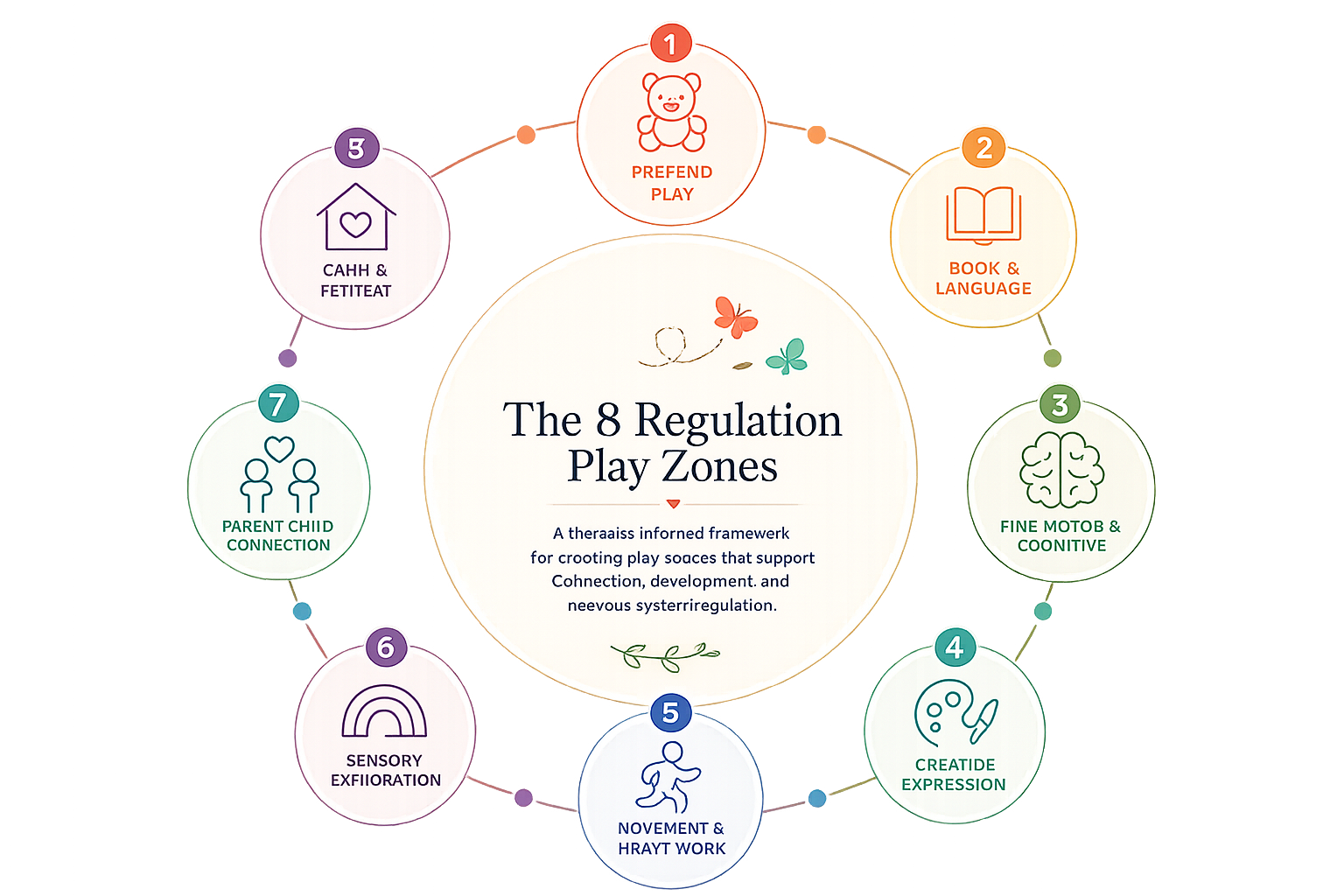
That's why we created the 8 Regulation Play Zones™.
Grounded in child development, nervous system regulation, and play-based learning, each zone supports a different way children naturally engage with the world around them.
Together, the zones provide a therapist-informed framework that helps families create environments that support regulation, learning, independence, creativity, connection, and meaningful play.
Because when we understand what a child needs beneath the behavior, we can stop guessing—and start designing spaces that truly support them.